
Why pasture
What pasture does for an egg.
A hen's diet and daily life show up in her eggs. Here's what researchers have found when hens get real time on grass, and what that research does and doesn't tell us.
How hens are raised
Egg cartons use four common terms. Here's what each one means for the hens.
-
1
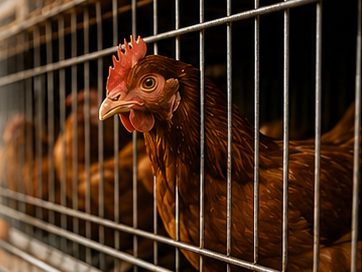
Caged
Hens live in wire cages, several to a cage, with little room to move or spread their wings.
- No outdoor access
- Little room to walk, perch or dust-bathe
-
2
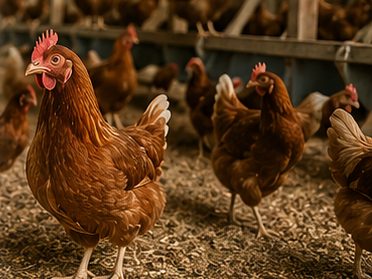
Cage-free
Hens move freely inside a barn, usually with perches and nest boxes.
- Room to walk, perch and nest
- No outdoor access required
-
3
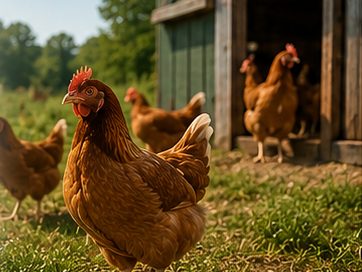
Free-range
Cage-free hens with access to the outdoors. The outdoor area can be small, and it may be bare ground.
- Fresh air and sunlight
- Certified Humane free-range: 2 sq ft outdoors per hen
-
Our hens
4
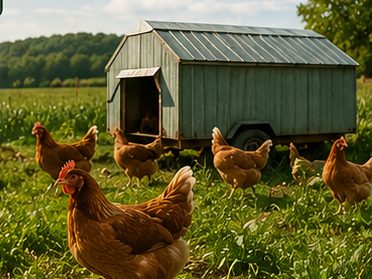
Pasture-raised
Hens spend their days outside on living, rotated pasture and come into a secure barn at night.
- Grass, alfalfa, bugs and seeds to forage
- Certified Humane pasture-raised: 108 sq ft of rotated pasture per hen
Cage-free and free-range follow USDA's definitions for graded eggs. "Pasture-raised" has no USDA definition, so the space figures are from the Certified Humane program. Goode Pickens Farms follows pasture-raised practices but is not Certified Humane. Photos are illustrations.
What hens find on pasture
Fresh greens
Alfalfa, clover and grasses add plant nutrients that a bag of feed alone doesn't supply. We're planting alfalfa and grasses for our flock.
Bugs and seeds
Foraging hens eat insects and seeds, a natural part of a chicken's diet.
Sunlight
Like people, hens make vitamin D in sunlight, and some of it ends up in their eggs.
What the research found
In a Penn State study, researchers compared eggs from sister hens kept on pasture with eggs from hens kept in cages. The caged eggs are the baseline (1×).
Vitamin E
Pastured vs. caged hens · Penn State, Karsten et al. 2010
Omega-3 fatty acids
Pastured vs. caged hens · Penn State, Karsten et al. 2010
Vitamin A (concentration)
Pastured vs. caged hens · Penn State, Karsten et al. 2010. Total vitamin A per egg did not differ.
Vitamin D
Hens kept outdoors vs. indoors · Kühn et al. 2014. Depends on time spent outside.
A better balance of fats
The same Penn State study found that pastured eggs had less than half the ratio of omega-6 to omega-3 fatty acids found in caged eggs.
How we're applying it
- We're planting perennial pasture of alfalfa and grasses, two of the forages in the Penn State study.
- Once grown, our hens will head out to forage each day and return to a secure barn at night.
- When our flock is laying, we plan to have our eggs tested by an independent lab and share the results here.
Sources
- Karsten, H.D., Patterson, P.H., Stout, R. & Crews, G. (2010). Vitamins A, E and fatty acid composition of the eggs of caged hens and pastured hens. Renewable Agriculture and Food Systems, 25(1), 45–54. Read the abstract
- Kühn, J., et al. (2014). Free-range farming: a natural alternative to produce vitamin D-enriched eggs. Nutrition, 30(4), 481–484.
- Anderson, K.E. (2011). Comparison of fatty acid, cholesterol, and vitamin A and E composition in eggs from hens housed in conventional cage and range production facilities. Poultry Science, 90(7), 1600–1608.
This page summarizes published research on eggs from pasture-raised and outdoor hens in general. It is not a claim about the nutrient content of Goode Pickens eggs, which have not yet been tested, and it is not medical or nutrition advice.
Be first in line for our eggs
Join the list for first eggs, market dates and Farm Day invites.
Join the list